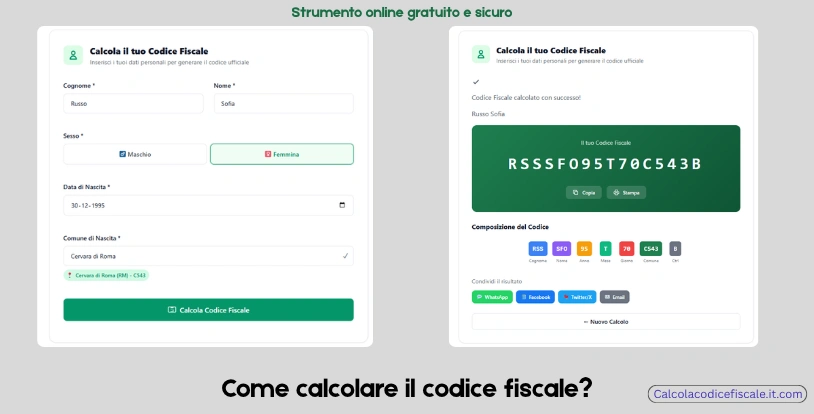
How to Calculate Your Tax Code: Easy Steps Using Online Tool
Your tax code is a 16-character alphanumeric ID, and you can calculate it fast with a Formula and online tool, then check it on your Health Card.
What Is the Italian Tax Code and Why It Matters
A tax code is a 16-character alphanumeric ID used for taxes and identity. It helps you open a bank account, sign contracts, handle health service care, and file tax returns.
- Introduced in Italy in 1973
- Rules set by a 1974 ministerial decree
Free Online Tax Code Calculator – Quick Start
Use the free online calculator by entering your full name and surname, birth date, municipality of birth, and gender. The generated result is for information only, so verify it on your Health Card or with the Revenue Agency.
- Enter your name and surname
- Select your date of birth
- Indicate your birth municipality
- Choose your gender
- Submit to generate the code
16‑Character Structure of the Tax Code
The tax code follows an official structure, and the algorithm is set by the Ministry of Economy and Finance. It is always 16 characters total, grouping personal data and a final control character.
| Position | Characters | What it Represents |
|---|---|---|
| 1-3 | 3 letters | Surname |
| 4-6 | 3 letters | Name |
| 7-8 | 2 numbers | Year of birth |
| 9 | 1 letter | Month of birth |
| 10-11 | 2 numbers | Day of birth + gender |
| 12-15 | 4 characters | Belfiore Code (municipality or foreign state) |
| 16 | 1 letter | Control character |
Step 1 – Deriving the Surname Letters
First, take consonants of the surname from left to right. Next, if there are fewer than 3 consonants, add vowels. Finally, if the surname is too short, pad with X.
- ROSSI → R, S, S → RSS
- WHITES → B, N, C → BNC
- BO → B + O + X → BOX
Step 2 – Deriving the Name Letters (Special Four‑Consonant Rule)
For the name, the special four-consonant rule applies to the first name only. If the name has 4 or more consonants, take the 1st, 3rd, and 4th consonants.
If the name has 3 consonants or less, take consonants in order, then add vowels if needed. Examples: MARIO → M, R + A → MRA, MARIKA → MRK.
- FRANCESCO → FNC
- JOSEPH → GPP
- LIA → LIA
Step 3 – Encoding Birth Year and Month
Positions 7-8 are the last two digits of the birth year. Then position 9 uses a letter for the month, and letters missing from the month set are F, G, I, N, O, and Q to avoid confusion.
| Month | Letter |
|---|---|
| January | TO |
| February | B |
| March | C |
| April | D |
| May | AND |
| June | H |
| July | THE |
| August | M |
| September | P |
| October | R |
| November | S |
| December | T |
Step 4 – Encoding Birth Day and Gender
Positions 10-11 encode the day plus gender. Men use the day as-is, from 01 to 31, while women add 40 to the day, making values from 41 to 71.
| Date | Gender | Calculation | Result |
|---|---|---|---|
| March 7 | Male | 07 | 07 |
| March 7 | Female | 07 + 40 | 47 |
| December 31 | Female | 31 + 40 | 71 |
Step 5 – Adding the Belfiore Code of the Birthplace
Positions 12-15 store the Belfiore code, a four-character place code for birth. It uses 1 letter plus 3 numbers for Italian municipalities, while births abroad use Z plus 3 numbers.
- Rome → H501
- Milan → F205
- Naples → F839
- Turin → L219
- Palermo → G273
Abroad examples: Germany → Z112, France → Z110, Albania → Z100. Also, abolished municipalities can keep the old code for births before the change.
Step 6 – Calculating the Control (Check) Character
Position 16 is the control character, also called CIN. It uses odd positions and even positions, converts characters to numeric values using two tables, adds them, divides by 26, and maps the remainder to a letter.
Because manual calculation is complex, use the calculator to avoid mistakes.
Remainder mapping: 0=A, 1=B, … 25=Z.
Practical Example: Full Tax Code Calculation from Scratch
Now apply the steps to Marco Bianchi, born 15 May 1985, in Rome, male. Each step follows the surname, name, year, month, day, Belfiore code, then the control character.
- Surname BIANCHI → consonants B, N, C → BNC
- Name MARCO → consonants M, R + A → MRC
- Year 1985 → 85
- May → AND
- Day 15, male → 15
- Rome Belfiore → H501
- Control character → X
Final code: BNCMRC85E15H501X.
Special Cases and Exceptions
Special cases change inputs, not the overall idea. So focus on X padding, homocody rules, compound name formatting, and the difference between provisional and official codes.
Short Names and Surnames (X Padding)
Short names and surnames get padded with X. Examples: BO becomes BOX, LI becomes LIX, and RE becomes REX.
- BO → BOX
- LI → LIX
- RE → REX
Homocody – When Two People Share the Same Code
Homocody happens when two people end up with the same code for matching first name, last name, date of birth, and place of birth. In that case, the Revenue Agency replaces one or more numbers with equivalent letters.
| Number | Letter |
|---|---|
| 0 | THE |
| 1 | M |
| 2 | N |
| 3 | P |
| 4 | Q |
| 5 | R |
| 6 | S |
| 7 | T |
| 8 | U |
| 9 | V |
Only the Revenue Agency can assign these modified codes.
Compound Surnames and Double Names
For compound surnames like De Luca or Di Marco, remove spaces and treat all letters as one word. For double given names like Maria Grazia or Giovanni Paolo, only the first given name is used.
Temporary vs. Official Tax Code
A calculated tax code is provisional and generated by online calculators, mainly for checks and consultations. An official tax code is issued by the Revenue Agency and appears on the Health Card for legal purposes.
- Calculated (provisional): informational, not legal
- Official: issued by Revenue Agency, on Health Card
How to Request the Official Tax Code
To get an official tax code, use the right authority based on your situation. So match your case to Italian citizens, foreign citizens, or newborns.
Italian Citizens
Italian citizens can request a tax code to the Revenue Agency using form AA4/8. Also, for newborns, it is assigned at the municipality at the time of birth.
- Valid identity document
- For minors, a parent document
Foreign Citizens
Foreign citizens can apply to the Revenue Agency, or through the Italian consular representation in their country of residence. Also, residents in Italy use residence permit, and abroad use an identity certificate from the consulate.
- Valid passport
- Residence permit (if resident in Italy)
- Consulate-issued identity certificate (for residents abroad)
Newborns
When a child is born, parents register the birth at the Municipal Registry Office. Next, the tax code is assigned automatically and the Health Card arrives at home within a few weeks.
Verifying a Tax Code (Reverse CF)
Reverse tax code verification checks formal correctness and lets you read the birth date, birthplace municipality or state, and gender. It cannot give the exact name or surname.
Summary of the Fundamental Rules
Here are the key rules for calculating your tax code: it has 16 characters, the first 6 come from surname and name, year uses last 2 digits, women add 40 to the birth day, birthplace uses Belfiore codes, and the final control character validates the string.
- 16 characters (alphanumeric)
- Surname and name rules
- Gender day offset (women +40)
- Belfiore code positions 12-15
- Control character at position 16
- Official issuance by Revenue Agency
Frequently Asked Questions
You can verify by comparing it with the one on your Health Card, using an online reverse tax code service, or checking on the Revenue Agency website.
No, it is impossible. You need all five details: first name, last name, date of birth, place of birth, and gender to generate a correct full 16-character code.
A tax code identifies natural persons with 16 alphanumeric characters. A VAT number identifies economic activities and freelancers with 11 numeric digits, and sole proprietors often have overlap between VAT and the owner’s tax code.
Yes, the same calculation rules apply. Parents do not calculate manually because the tax code is assigned automatically when the birth is registered with the municipality.
Yes, but only in limited situations: legal change of name or surname, correction of personal data errors, gender correction on documents, or resolution of homocody cases. The Revenue Agency issues a new tax code.
Positions 1-3 are surname letters, 4-6 are name letters, 7-8 are year digits, 9 is the month letter, 10-11 are day plus gender, 12-15 are the Belfiore code, and 16 is the control character.